How to build a greenhouse business case before you spend a euro
Three numbers decide your hydrangea greenhouse success before you spend a euro: variety-to-market fit, fertigation and climate cost per square meter, and break-even timeline.
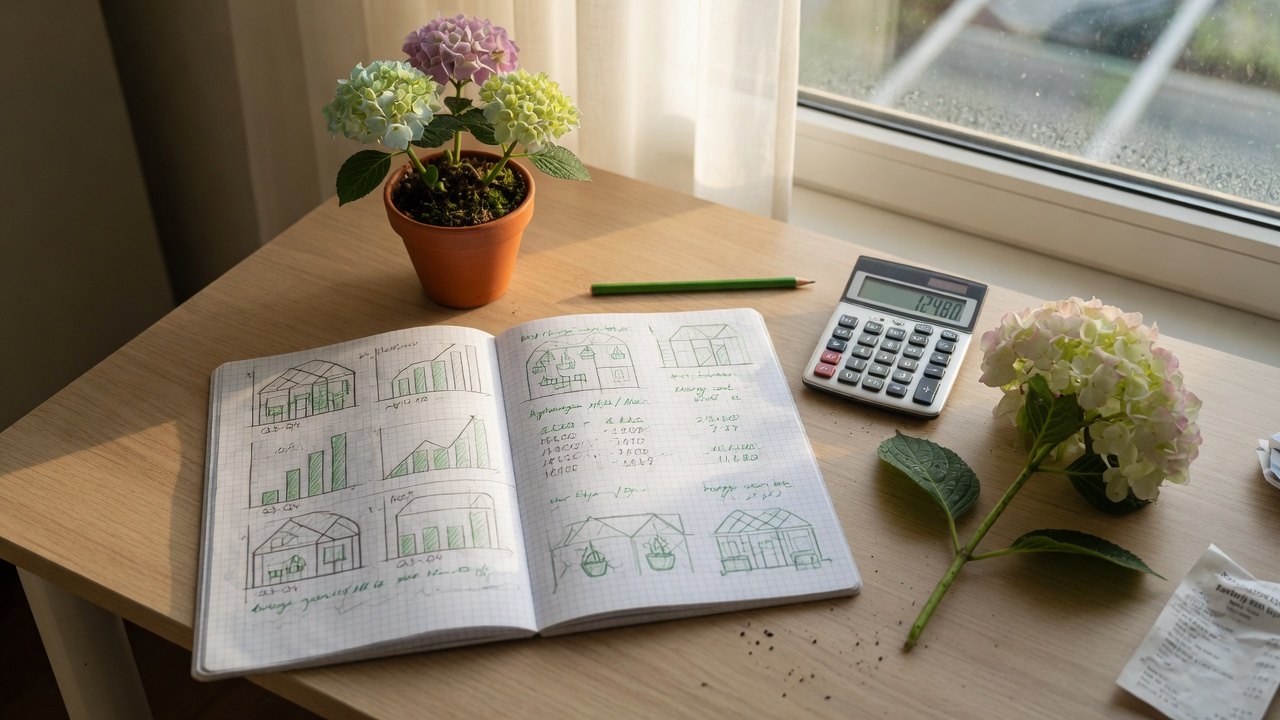
You have a vision of a profitable hydrangea greenhouse. You have land, maybe a structure, or just a burning desire to escape the chaos of unpredictable markets. But before you commit a single euro to construction, plants, or equipment, you need a business case. Not a spreadsheet full of wishful thinking. A cold, hard model that tells you if your project can survive reality. As a founder who has worked with growers across continents, I have seen too many smart people lose money because they fell in love with the idea before they tested the numbers. This article walks you through the three numbers that decide everything: variety-to-market fit, fertigation and climate cost per square meter, and break-even timeline. You will learn how to model your capital expenditure and adopt a P&L mindset before you break ground.
Number one: variety-to-market fit
Your first decision is not how many square meters to build. It is which varieties to grow. The market does not reward effort. It rewards the right product at the right time. A variety that sells at a premium in Amsterdam may be a loss leader in Dubai. You need to match your chosen cultivars to your target buyers: local florists, export wholesalers, or direct-to-consumer subscription boxes. In our flagship course Growing Hydrangeas for Cutting: from A to Z, we emphasize that 80% of flower growers lose profit through weak flowering, watering and fertilizing errors, incorrect cutting and storage, and color that does not match market expectations. That statistic comes from real data across dozens of farms. The solution is to select varieties that are proven to thrive in your climate and command a price that covers your costs plus margin.
- Research local demand. Talk to wholesalers and florists. Ask what colors and stem lengths they struggle to source. Build your variety list around gaps, not guesses.
- Test before you scale. Run a small trial with 100 to 200 plants of your top three candidates. Measure yield per plant, stem quality, and vase life.
- Calculate potential revenue per square meter. Multiply stems per plant by plants per square meter by average price per stem. This gives you a top-line number that must exceed your total cost per square meter.
Number two: fertigation and climate cost per square meter
Your second number is the operating cost that will consume the largest share of your revenue: fertigation and climate control. In a modern hydrangea greenhouse, heating, cooling, irrigation, and fertilization are not optional. They are the levers that determine whether your plants produce marketable stems or green waste. You must model the cost of energy (gas, electricity, or renewable sources), water and nutrients, and the labor to manage the system. A common mistake is to underestimate climate cost by assuming a mild winter. Plan for the coldest year in the last decade. Then add 15%.
- Map your local energy prices. Contact your utility provider and get the per-kilowatt-hour or per-cubic-meter rate for the past three years. Use the highest as your baseline.
- Estimate water and fertilizer consumption. A mature hydrangea plant needs about 2 to 3 liters per day in peak season. Multiply by plant count and days. Add 20% for runoff and system losses.
- Factor in technology like IRISS. Our partner 4MT offers a computer-vision sorting system that reduces labor cost and improves grading accuracy. The upfront investment pays back through lower per-stem sorting cost and higher pack-out rates. Include its depreciation in your cost per square meter.
"We started spending less and earning more. The numbers worked because we built the model before we built the greenhouse." - Abdulla Khadziev, GM of Kantyshevsky greenhouse complex
Number three: break-even timeline
The third number is the one that keeps you honest: how many months or years until your cumulative profit equals your total investment. This is not a vanity metric. It is the measure of whether your business can survive the valley of death. For a typical hydrangea greenhouse, the break-even point ranges from 18 to 36 months, depending on scale, variety, and market access. To calculate it, you need a simple P&L mindset. Start with your capital expenditure: land, structure, climate equipment, irrigation system, and initial plant material. Then estimate your annual revenue minus operating costs. Divide the initial investment by the annual net profit. That gives you years to break even.
- Include a contingency fund. Add 20% to your capex for unexpected delays, price increases, or crop failures. This is not pessimism. It is professionalism.
- Model three scenarios. Optimistic (best yield, highest price), realistic (average yield, average price), and pessimistic (low yield, low price). Your financing and your peace of mind depend on the realistic scenario.
- Use the free diagnostic quiz. Before you build a full spreadsheet, take our System or Chaos? quiz. It will reveal whether your current approach is structured or scattered, and give you a customized starting point for your business case.
Building a greenhouse business case is not a one-time exercise. It is a living document that you update as you gather real data from your trial, your market research, and your first season. The three numbers we covered are the foundation. Once you have them, you can make informed decisions about capex, financing, and timing. If you want a deeper dive into the specific numbers for hydrangeas, including sample P&L templates and case studies from growers who have done this successfully, explore our business case resources and consider joining the full course where we walk through every step with real examples. Your greenhouse can be profitable. But only if you let the numbers lead, not your emotions.
Put this into practice
The flagship program turns thinking like this into a season-by-season system.
Explore the program