System or chaos: seven signals your greenhouse is leaking margin
Seven concrete signals your greenhouse is leaking margin, and a free diagnostic to pinpoint which one is costing you most.
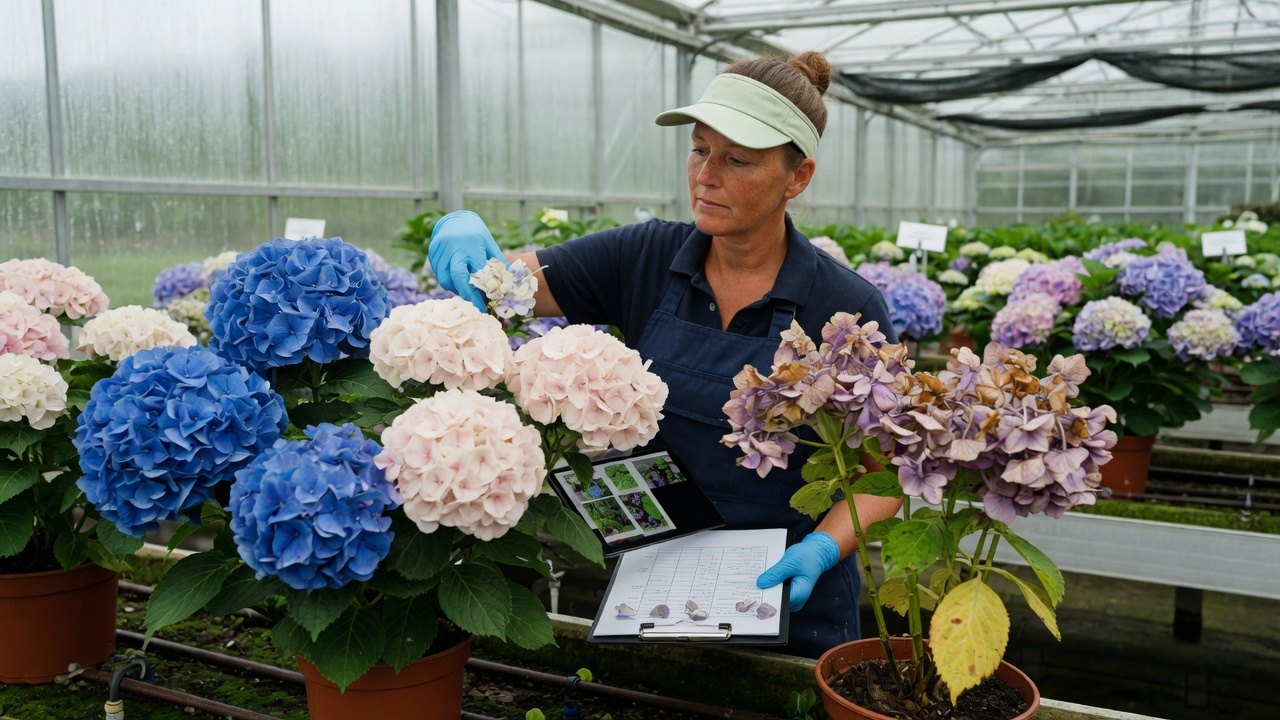
Every euro that leaves your greenhouse without returning as profit is a leak. Some leaks are obvious: a broken pipe, a failed pump. Others are silent. They hide in inconsistent color, in unplanned feed changes, in the feeling that you are working harder than last year but earning the same. Over 80 percent of flower growers lose profit through weak flowering, watering and fertilizing errors, incorrect cutting and storage, or color that does not match market expectations. The good news is that most leaks can be sealed. The better news is that you do not need to guess which ones apply to you.
Signal one: inconsistent color across batches
If your hydrangeas vary in hue from week to week, your customers notice before you do. Color inconsistency is almost always a symptom of unstable pH, unbalanced nutrition, or irregular watering. Each batch becomes a gamble. You lose margin when you discount off-color stems or when a buyer rejects a shipment.
- pH drift. A shift of 0.3 points can turn blue to muddy purple. Check your irrigation water weekly.
- Nutrient lockout. High calcium or bicarbonate blocks iron uptake. Test your substrate every two weeks.
- Variety mismatch. Not all cultivars respond the same way to your feeding program. If you grow multiple varieties, track each one separately.
Signal two: unplanned feed changes
You walk into the greenhouse and decide to switch fertilizers because the leaves look pale. You adjust the EC by feel. This is chaos disguised as intuition. Unplanned feed changes are the second largest cause of yield loss in commercial hydrangea production.
“When you change the feed without data, you are not solving a problem. You are creating a new one.”
The fix is not a better fertilizer. It is a system that tells you exactly what to apply and when. A structured feeding schedule based on leaf tissue analysis and substrate EC targets removes the guesswork.
Signal three: surprise capital expenditure
A pump fails. A boiler needs replacement. A cooling system stops working in July. These surprises are not bad luck. They are symptoms of deferred maintenance and a lack of preventive planning. Every unexpected capex pulls cash from your bottom line and delays investment in things that actually grow revenue.
- Calculate your maintenance ratio. Aim for 1 to 2 percent of your annual turnover spent on preventive maintenance.
- Create a 5-year capex calendar. Replace major equipment before it breaks, not after.
- Build a buffer. Keep three months of fixed costs in liquid reserves.
Signal four: no break-even model
You know your total cost per square meter, but do you know the exact yield and price you need to break even on every cultivar? Most growers do not. Without a break-even model, you are flying blind. You accept prices that feel fair but are actually below your cost.
A proper break-even model includes fixed costs, variable costs, expected yield per square meter, and a realistic price range. Update it every season. Use it before you negotiate with buyers, not after.
Signal five: daily firefighting
If your morning routine is a list of emergencies, you have a systems problem. Firefighting burns time, energy, and margin. It prevents you from working on the business because you are always working in the business.
- Log your interruptions. For one week, write down every unscheduled task. At the end, categorize them. Most will fall into three buckets: missing standard operating procedures, insufficient training, or poor equipment reliability.
- Create one SOP per month. Start with the task that causes the most firefighting. Write it down, train your team, and move on.
Signal six: your team is always guessing
When you ask your head grower why they changed the irrigation schedule and they say “I felt it was too dry,” you have a knowledge leak. A system removes feelings. It replaces them with data and protocol. Your team should not need to guess. They should need to follow.
Signal seven: you are not tracking yield per square meter
Yield per square meter is the single most important metric in cut-flower production. If you do not measure it, you cannot improve it. Abdulla Khadziev, general manager of the Kantyshevsky greenhouse complex, doubled his yield per square meter after applying a structured system. His profitability increased because he started spending less and earning more.
Tracking yield per square meter forces you to confront inefficiencies. It reveals which cultivars perform and which ones waste space. It tells you if your investments in climate control, irrigation, and labor are paying off.
You can seal these leaks. The first step is diagnosis. Take the free System or Chaos? quiz and get a clear picture of where your greenhouse is bleeding margin. Then explore the Growing Hydrangeas for Cutting: from A to Z program, where Ard van Klaveren and I teach the exact systems that help growers like you move from chaos to predictable profit.
Put this into practice
The flagship program turns thinking like this into a season-by-season system.
Explore the program