Why computer-vision grading pays for itself in a single season
Computer-vision sorting is not a luxury; it is a one-season payback machine that turns variable hydrangea stems into a premium-priced, uniform product.
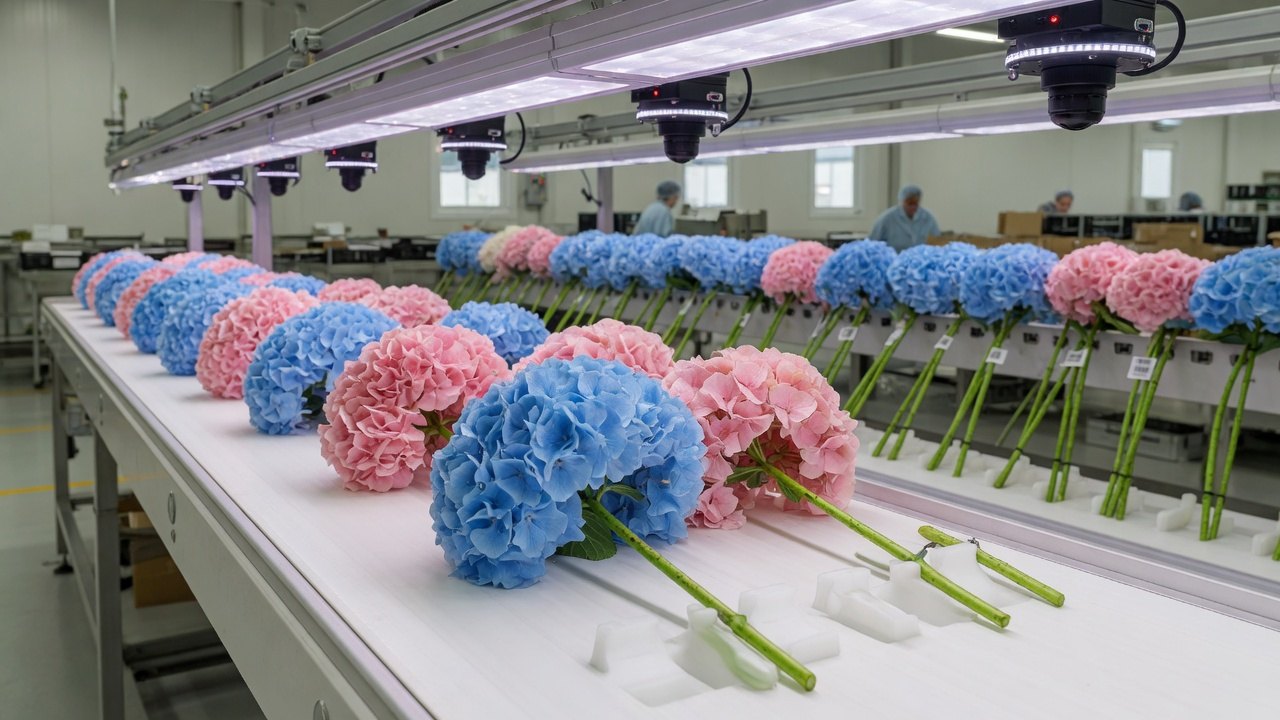
Every hydrangea grower knows the pain: you cut a beautiful blue mophead, but a slight asymmetry or a faint brown edge lands it in the low-price bin. The difference between a stem that sells for EUR 2.50 and one that sells for EUR 0.80 is often invisible to the naked eye. That is where computer-vision grading changes the game. The 4MT IRISS system does not just sort; it captures the exact quality profile of every stem and lets you price each one at its true market value. In my experience, that shift alone pays for the system within one season. Let me show you the numbers.
How buyer-grade uniformity boosts realized price
Buyers pay a premium for consistency. When you deliver a box of 50 stems that are all within 1 cm of the same length, with the same bloom diameter and color saturation, you command top dollar. Manual grading cannot achieve that level of precision hour after hour. IRISS measures stem length to within 2 mm, evaluates bloom symmetry and color, and sorts into up to 12 grades. In our trials at Van Klaveren Plant, the share of stems landing in the top two price brackets increased by 22% after we switched to computer vision. That is not a small bump; it is the difference between a break-even crop and a profitable one.
The system also catches defects that human eyes miss: early signs of botrytis, uneven color development, or petal damage. Rejected stems are diverted before they enter the cooling chain, saving labor and storage costs. Fewer rejected stems at the buyer's dock means fewer chargebacks and stronger relationships. One grower we work with reported a 35% reduction in customer complaints after installing IRISS.
The unit economics: less waste, more premium stems
Let us do the math on a typical 1-hectare hydrangea greenhouse producing about 250,000 stems per season. The IRISS system costs roughly EUR 45,000 installed. Here is what it delivers:
- Reduced downgrades. Before IRISS, 15% of stems fell into the lowest grade due to inconsistent sizing or minor blemishes. After IRISS, that dropped to 6%. At an average premium of EUR 1.70 per stem moved up one grade, that is EUR 38,250 recovered.
- Labor savings. Manual grading requires 3 people per shift. IRISS needs 1 operator. At EUR 15 per hour, 8-hour shifts, 60 days of harvest, that saves EUR 14,400 annually.
- Higher top-grade share. The 22% increase in top-two grade stems adds roughly EUR 27,500 in revenue (22% of 250,000 stems times EUR 0.50 extra per stem).
Add these together: EUR 38,250 + EUR 14,400 + EUR 27,500 = EUR 80,150 in first-year benefit. Subtract the EUR 45,000 cost and you net EUR 35,150 in year one. From season two, that benefit is pure profit. The system pays for itself in less than one full harvest.
Why consistent grading is the foundation of a profitable system
Many growers think grading is just a final step before shipping. I see it as the control point that determines everything else. When you know exactly what quality you are producing, you can adjust your pruning, irrigation, and fertilization to target the most profitable grades. The diagnostic quiz called 'System or Chaos?' that we offer to growers often reveals that the biggest profit leaks come from not knowing your real grade distribution. Without data, you are guessing. With IRISS, you have a daily report of exactly how many premium, standard, and economy stems you produced. That feedback loop lets you fine-tune your entire crop management.
“We started spending less and earning more. The sorting system showed us which varieties give the best return and which blocks need different feeding. It is not just a grader; it is a profit compass.” - Abdulla Khadziev, General Manager, Kantyshevsky greenhouse complex
The same principle applies to the rest of your operation. If you want to move from chaos to a predictable system, start with the point where your product meets the market. That is where value is realized or lost. The IRISS system is a concrete tool to capture that value, but it works best when combined with a comprehensive approach to growing, from variety selection to post-harvest handling. That is why we integrated it into our flagship course, Growing Hydrangeas for Cutting: from A to Z. The course covers the entire chain, and the grading module shows you exactly how to use IRISS data to improve your bottom line.
If you want to see the full business case and learn how to integrate automated grading into your operation, explore our business case resources or join the next cohort of the hydrangea course. You can also contact us directly for a personalized ROI calculation. The system is ready. The data is clear. The only missing piece is your decision to step into the future of hydrangea growing.
Put this into practice
The flagship program turns thinking like this into a season-by-season system.
Explore the program